
By Godson Azu
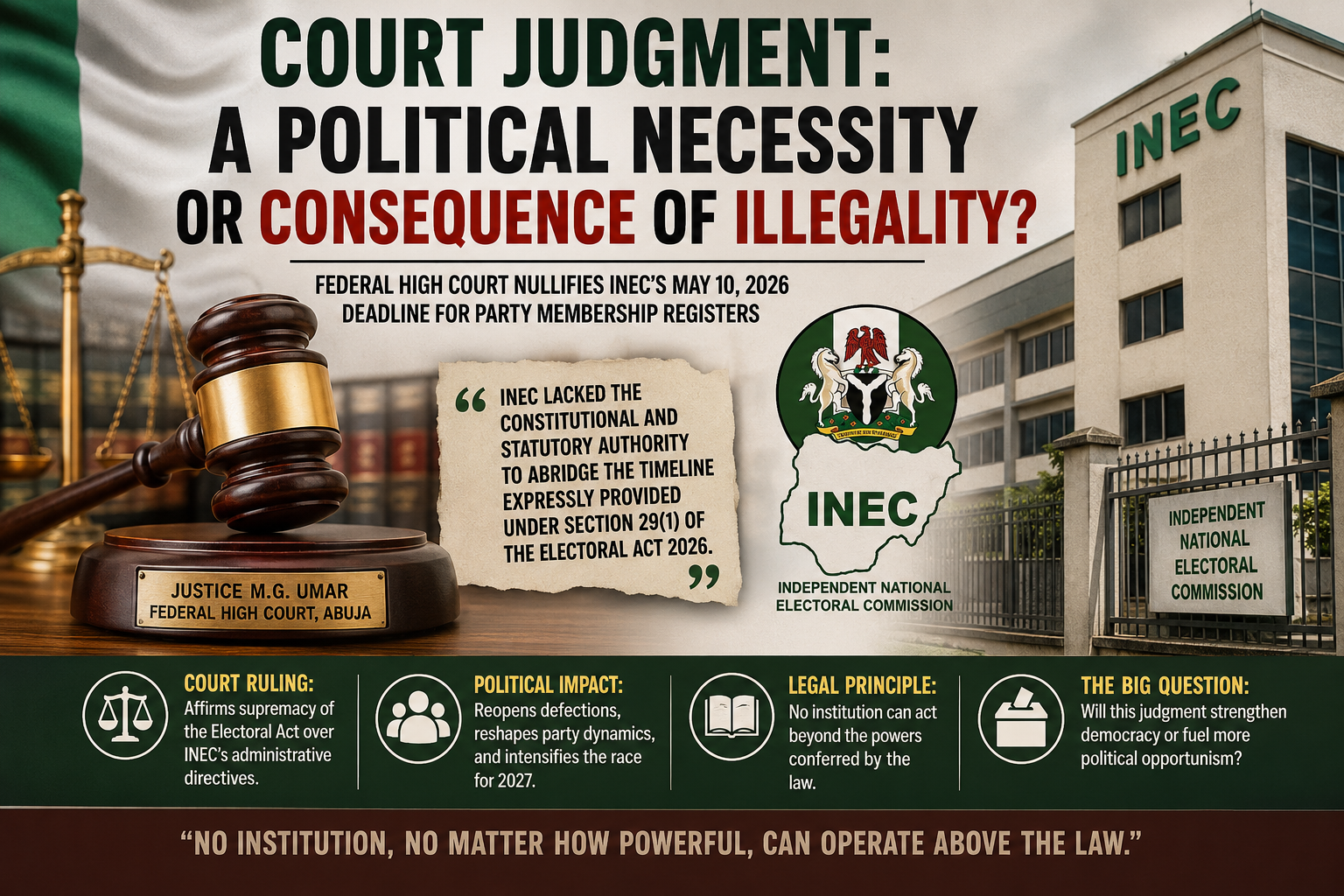
The recent judgment delivered by Justice M.G. Umar of the Federal High Court, Abuja, nullifying the Independent National Electoral Commission (INEC)’s directive requiring political parties to submit their membership registers by May 10, 2026, has opened a significant constitutional, political, and democratic debate ahead of Nigeria’s 2027 general elections.
The ruling has not only reignited conversations about the limits of INEC’s regulatory authority, but has equally exposed the recurring tension between administrative convenience and constitutional legality in Nigeria’s electoral process.
According to Dr. Monday Ubani, a respected legal practitioner, Senior Advocate of Nigeria (SAN), and public policy analyst, the judgment represents a reaffirmation of the supremacy of statutory law over administrative directives. In his interpretation of the ruling, Justice Umar held that INEC lacked the constitutional and statutory authority to abridge the timeline expressly provided under Section 29(1) of the Electoral Act 2026.
The section clearly stipulates that political parties shall submit the particulars of their candidates “not later than 120 days before the date appointed for a general election.” By implication, political parties and intending defectors now have until September 2026 to regularize their membership status and submit relevant documentation.
From a constitutional perspective, the court’s reasoning appears firmly rooted in established legal doctrine. INEC, though constitutionally empowered to regulate elections, remains a statutory body created by law. Consequently, its regulations, guidelines, and administrative timetables cannot supersede the provisions of the Electoral Act enacted by the National Assembly.
In Nigerian jurisprudence, the doctrine is well settled: where there is a conflict between a principal statute and subsidiary legislation, the statute prevails. Administrative actions derive their legitimacy from the enabling law and cannot extend beyond the authority granted therein.
Justice Umar’s judgment therefore reinforces a longstanding constitutional principle — delegated powers cannot exceed the parent statute from which they derive authority.
However, beyond the legal technicalities lies a deeper political reality.
INEC’s intention may not necessarily have been unlawful in purpose, even though the court found its implementation inconsistent with statutory provisions. From an administrative standpoint, the Commission may have sought to create electoral stability, reduce confusion in party primaries, and prevent the perennial crisis of last-minute defeions and candidate substitutions that have historically undermined Nigeria’s democratic process.
One may reasonably assume that INEC intended to stabilize party structures early enough to discourage political opportunism and the culture of transactional defections. Early submission of party membership registers would also have provided sufficient time for verification processes, internal monitoring, and logistical preparations ahead of the elections.
Yet, administrative convenience, no matter how noble its intentions, cannot override rights expressly guaranteed by legislation.
This is where the doctrine of ultra vires becomes central. Once a public institution acts beyond the powers conferred on it by law, such action becomes null and void to the extent of its inconsistency. The Supreme Court of Nigeria has consistently held that subsidiary legislation cannot amend, vary, diminish, or indirectly defeat the provisions of a principal statute.
Therefore, if Section 29 of the Electoral Act grants political parties until 120 days before the election to submit candidates’ particulars, INEC cannot lawfully create an earlier mandatory deadline that effectively extinguishes participation rights guaranteed by the Act itself.
Politically, the implications of this judgment are profound and potentially disruptive.
First, the ruling effectively reopens Nigeria’s political transfer market ahead of the 2027 elections. Politicians dissatisfied with the outcomes of party congresses, zoning arrangements, or internal power struggles now have additional time to defect to rival political parties and seek fresh nominations.
This may trigger one of the largest waves of political realignments in Nigeria’s recent democratic history.
Secondly, the judgment significantly limits INEC’s future ability to impose regulatory deadlines outside the framework of the Electoral Act. Electoral guidelines will now likely face greater judicial scrutiny, compelling the Commission to align every procedural directive strictly within statutory boundaries.
Thirdly, political parties may experience prolonged uncertainty regarding membership structures, primary elections, candidate negotiations, and coalition arrangements. Rather than stabilizing the political atmosphere, the ruling could intensify internal party conflicts and fuel elite bargaining across party lines.
The judgment may equally deepen public cynicism about the ideological emptiness of Nigerian politics, where party defections are often driven less by principle and more by personal ambition, survival, or access to state power.
Given the national significance of the matter, there is every likelihood that the case may proceed to the Court of Appeal and ultimately the Supreme Court for a definitive interpretation of the scope of INEC’s constitutional and statutory powers.
On the broader democratic scale, however, the ruling reinforces a critical principle essential to constitutional governance: no institution, no matter how powerful or influential, can operate above the law.
As Nigeria approaches another electoral cycle, this judgment may emerge as one of the most consequential legal decisions shaping the political architecture of the 2027 elections.
Interestingly, the debate surrounding the ruling has also exposed deeper concerns about legislative timing, executive oversight, and institutional preparedness.
During a discussion on Arise News, Sumner Sambo, Director of News and Politics Editor, argued that the Presidency failed to exercise sufficient diligence before assenting to the Electoral Act 2026 as amended. According to him, INEC realistically had enough operational time between May and September 2026 to organize its processes effectively.
He questioned why the Commission appeared eager to compel political parties to conclude internal primaries and submit candidate details prematurely. In his analysis, part of the current confusion stems from the National Assembly’s delay in passing the Electoral Act within a reasonable timeframe. Ideally, such electoral legislation should have been finalized by December 2025 to allow adequate time for INEC’s planning, logistics, and stakeholder coordination.
This argument introduces another dimension to the controversy: was INEC genuinely acting out of administrative necessity, or was it attempting to compensate for institutional delays and legislative inefficiencies?
The political consequences of this ruling therefore remain open to interpretation.
To some observers, the judgment strengthens constitutional democracy and protects political participation rights. To others, it creates an escape route for opportunistic politicians seeking convenient platforms after losing influence within their original parties.
Questions naturally arise:
Who truly benefits from this judgment?
Is it the ruling political elite seeking strategic defections?
Is it the fragmented opposition attempting to rebuild coalitions?
Or is it merely another episode in which the electorate watches political actors manipulate legal processes for personal advantage?
These concerns are further complicated by Nigeria’s longstanding judicial credibility challenges. Public trust in the judiciary has, over the years, suffered significant reputational damage due to allegations of political interference, corruption, contradictory rulings, and perceived elite influence.
Consequently, while many legal analysts believe an appeal against the judgment may ultimately fail on constitutional grounds, public skepticism remains unavoidable. In Nigeria’s political environment, legal battles are often interpreted not merely through the lens of law, but through the prism of power, influence, and political negotiation.
Ultimately, Justice Umar’s judgment stands as a powerful reminder that democracy is governed not by administrative preferences, but by constitutional boundaries and statutory authority.
INEC may possess broad powers to regulate elections, but those powers remain subject to the Constitution and the Electoral Act. The judiciary, in this instance, appears to have reaffirmed that even electoral management bodies must operate strictly within the confines of legality.
As the nation gradually moves toward the 2027 elections, this ruling may significantly shape party defections, candidate eligibility battles, coalition negotiations, and the evolving balance of power between INEC, political parties, the judiciary, and the Nigerian electorate itself.
Whether history will ultimately remember this judgment as a triumph of constitutional order or a catalyst for greater political opportunism remains to be seen.
Mazi Godson Azu is a UK-based International Relations and Politics Expert, Commentator, Author and Consultant specialising in diplomacy, governance, diaspora engagement, trade and international affairs. A member of IoD Africa Group. Institute for Governance.