By Kachi Okezie , Esq
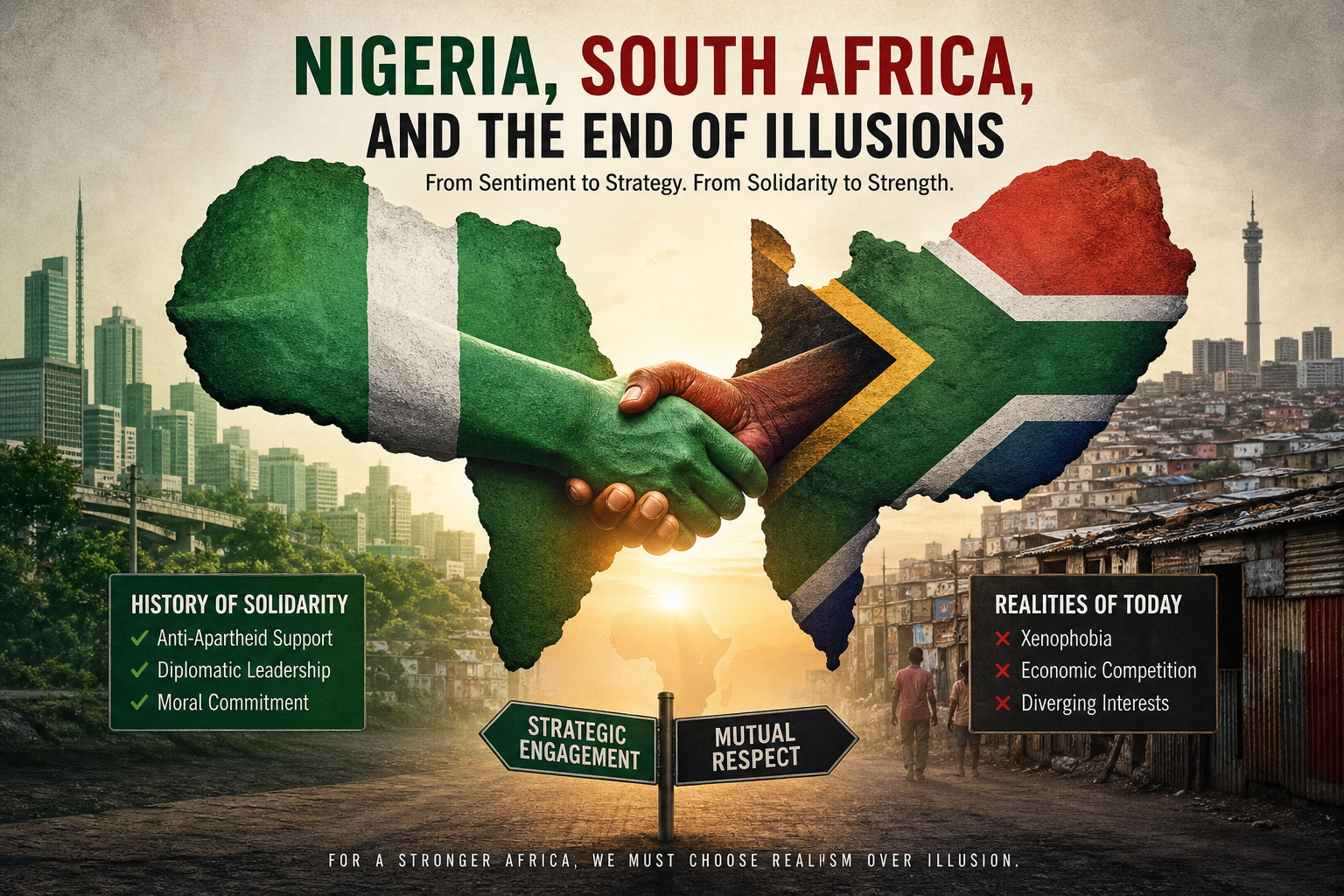
In international relations, there are no permanent friendships, only permanent interests. This is a truth Nigeria is being forced to confront, often painfully, in its relationship with South Africa. For many Nigerians, the recurring images of xenophobic violence, whether it’s shops looted, migrants attacked or lives otherwise disrupted, have become a source of deep worry. They also raise a profoundly emotional question: how did it come to this? How did a country Nigeria so vigorously supported during the anti-apartheid struggle become one where Nigerians now feel increasingly unwelcome?
The answer lies not in betrayal, but in a misunderstanding; one rooted in history, identity, and the limits of moral politics. Nigeria’s role in the dismantling of apartheid was not symbolic. It was decisive. For decades, Nigeria provided financial, diplomatic, and moral support to liberation movements like the African National Congress, hosted exiles, funded education, and mobilised international pressure through platforms such as the Organization of African Unity. This was not cheap. Nigeria committed vast resources at a time when those funds could have accelerated domestic development. Yet the decision was clear: apartheid was an affront to African dignity, and confronting it was a duty. History has vindicated that stance, but history does not pay dividends.
One of the quiet assumptions underlying Nigeria’s foreign policy at the time was that solidarity would be remembered, and requited. It has not been. This is not because South Africa is uniquely ungrateful. It is because states do not operate on memory; they operate on interest. Post-apartheid South Africa, symbolised by the rise of Nelson Mandela, emerged not as a dependent ally, but as a confident economic and political power pursuing its own priorities, expanding its corporations, protecting its markets, and managing its internal pressures. In that context, Nigeria became not just a partner, but also a competitor. The lesson is uncomfortable but necessary: moral leadership does not automatically translate into strategic advantage.
The xenophobic violence seen in South Africa is often interpreted in Nigeria as a direct affront, but its roots are largely domestic. South Africa remains one of the most unequal societies in the world, with high unemployment and deep structural tensions that have persisted since the end of apartheid. In such an environment, migrants—visible, industrious, and often concentrated in informal sectors—become easy scapegoats. This does not justify the violence, but it does clarify it. The problem is not historical amnesia; it is present-day pressure. Unless those pressures are addressed internally, outbreaks of hostility may continue regardless of diplomatic goodwill.
Nigeria’s miscalculation, therefore, was not in supporting the anti-apartheid struggle. That remains one of the country’s proudest contributions to global justice. The miscalculation was in assuming that solidarity alone was sufficient. Nigeria gave generously, but often without binding economic agreements, enforceable migration protections, or long-term strategic frameworks. In effect, it invested heavily in a future relationship without securing the terms of that relationship. That gap is now visible.
Today, Nigeria and South Africa are bound together, but not in the way many once imagined. They are Africa’s two largest economies, regional powerhouses, and competitors for influence across the continent. South African firms have expanded extensively into Nigeria, while Nigerian businesses frequently encounter barriers in South Africa. Diplomatic tensions flare intermittently, and public sentiment on both sides is increasingly shaped by suspicion rather than solidarity. This is not an anomaly; it is what happens when shared history gives way to overlapping ambition.
If Nigeria is to avoid repeating past mistakes, it must rethin, not abandon, its approach to African engagement. Support for other African countries must be tied to clear national outcomes. Goodwill is not a policy. Economic openness should be mutual, not one-sided. The safety of Nigerians overseas must become a central priority, not an afterthought, with diplomatic responses that are swift and consistent. Above all, Nigeria must recognise that foreign policy influence rests on domestic strength. No country can project power abroad if it is constrained at home.
This moment is not just about Nigeria and South Africa. It reflects a broader transition across Africa, as the continent moves from an era defined by shared struggle against external oppression to one shaped by internal competition and nation-building. Institutions like the African Union provide a framework for cooperation, but frameworks alone are not enough. What is required is a new political mindset—one that balances solidarity with strategy and ideals with interests.
There is a temptation to frame current tensions in emotional terms like betrayal, ingratitude, and disappointment. But sentiment is not strategy. Nigeria’s past actions were right. They helped dismantle one of the most unjust systems in modern history, and that legacy should remain a source of pride. Yet the future cannot be built on memory alone. What Nigeria must confront today is not South Africa, but its own assumptions: the belief that history guarantees loyalty, that solidarity ensures reciprocity, and that moral authority translates into material advantage.
Letting go of these illusions is not a loss. It is a necessary step toward clarity. Nigeria does not need to retreat from Africa; it needs to engage it differently: with structure, with discipline, and with confidence in its own interests. Only then can it transform past sacrifice into future strength, and only then can the promise of African unity move from sentiment to substance.