Tinubu’s Chain, Atiku’s Handshake and Obi’s Two Fingers: Three Political Personalities, Three Symbols, But Whose Freedom?
By Godson Azu
In politics, symbols speak. Personalities attract loyalty. Political parties mobilise support. But ultimately, it is the people who must benefit from the exercise of political power.
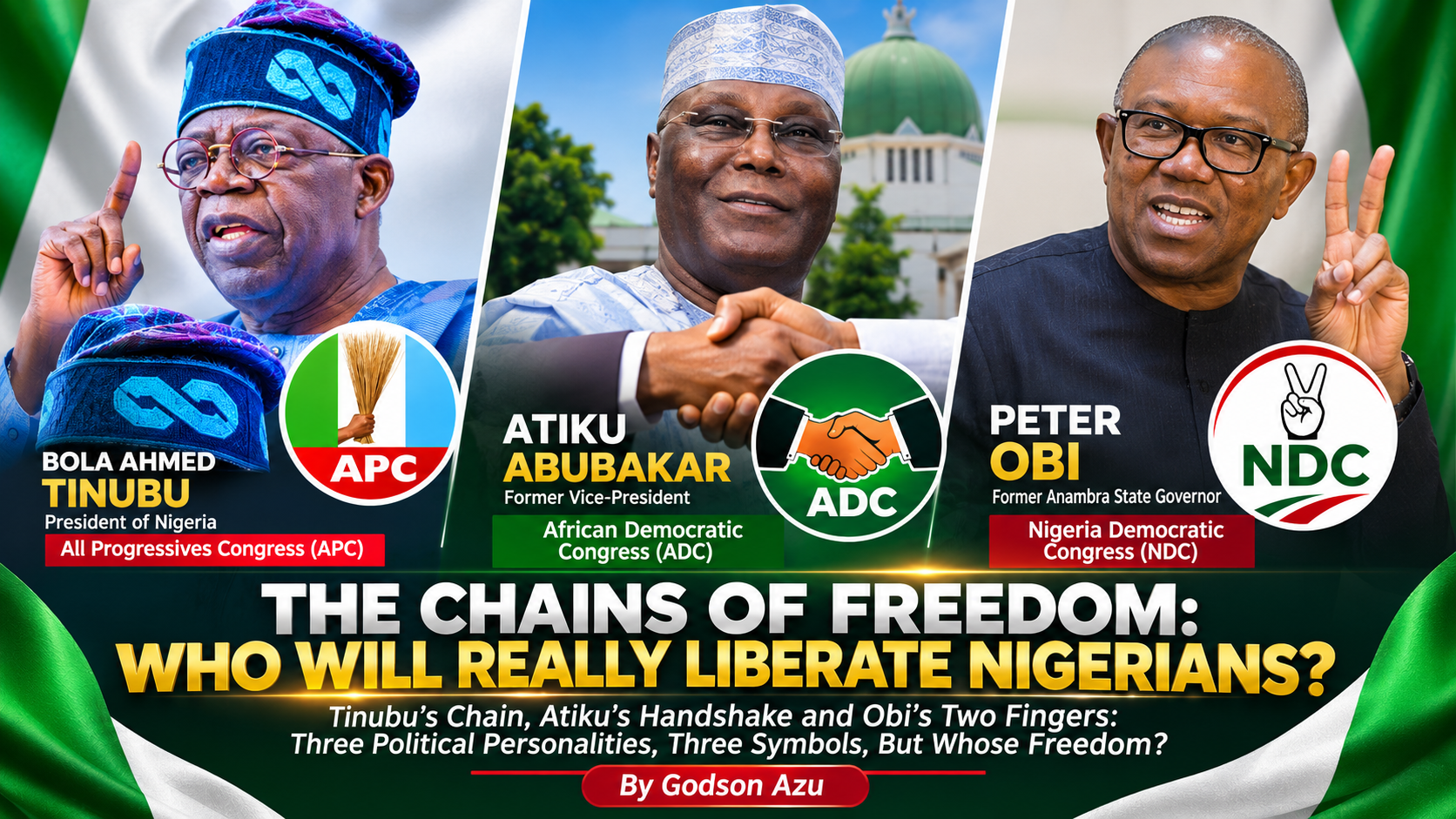
Nigeria’s political landscape presents an interesting comparison between three prominent political figures: President Bola Ahmed Tinubu of the All Progressives Congress (APC), former Vice-President Atiku Abubakar of the African Democratic Congress (ADC), and Peter Obi of the Nigeria Democratic Congress (NDC).
Their political identities, party affiliations, personal followings and symbols raise a fundamental question: are Nigerians choosing political ideologies and credible alternatives, or are they increasingly becoming loyal to political personalities?
Tinubu’s Chain, Atiku’s Handshake and Obi’s Two Fingers offer an interesting metaphor for examining the politics of personality, party identity, loyalty and the search for national liberation.
TINUBU: THE CHAIN AND THE BROOM
President Tinubu’s political identity is associated with his Jagaban title, extensive political network, strategic alliances and distinctive chain-like or broken-shackle imagery.
The symbolism of a broken chain suggests liberation, freedom and the breaking of limitations. But the question is unavoidable: if the chain represents freedom from poverty and hardship, how many ordinary Nigerians are actually experiencing that freedom?
The APC, meanwhile, has its own official symbol—the broom, representing collective strength and the promise of sweeping away obstacles.
The distinction matters. Tinubu’s personal political brand must not become synonymous with the entire identity of the APC. A political party should be bigger than its leader, stronger than its founder’s political network and governed by its constitution and collective ideology.
Tinubu’s political strength is his ability to build structures, negotiate alliances and organise political power. His greatest test, however, is whether his economic reforms and political leadership can deliver prosperity, security and a better standard of living.
The chain may be broken on the cap, but if the chains of hardship remain on the people, what exactly has been liberated?
ATIKU: THE HANDSHAKE AND THE POLITICS OF COALITION
Atiku Abubakar represents political experience, national networking, negotiation and a long journey through Nigeria’s political establishment.
His current political platform, the African Democratic Congress, introduces another powerful symbol: the handshake.
A handshake should represent unity, partnership, trust, reconciliation and collective purpose. It is an appropriate metaphor for a political coalition seeking to bring different interests together.
But is the ADC handshake a genuine commitment to national renewal, or simply another political arrangement in the struggle for power?
Atiku’s experience and advocacy of economic restructuring and a more decentralised federation remain important elements of his political proposition. Yet his challenge is to convince Nigerians that his experience can deliver a fresh direction rather than reproduce familiar political arrangements.
A handshake between political leaders is meaningless if the hands of ordinary Nigerians remain tied by poverty, insecurity, unemployment and economic exclusion.
PETER OBI: THE TWO FINGERS AND THE OBIDIENT GENERATION
Peter Obi represents a different political phenomenon: citizen-driven mobilisation, reform aspirations, prudent public spending, accountability and the growing demand for a different approach to governance.
The Obidient movement has become a significant political force, particularly among young people and Nigerians who believe that the country needs a new political direction.
Now associated with the Nigeria Democratic Congress, Obi’s political identity must be distinguished from the party’s official two-finger victory symbol.
The two fingers communicate victory, hope and aspiration. But political victory must mean more than winning an election. It must translate into better governance, stronger institutions, economic opportunities and national development.
Obi’s greatest strength is the public enthusiasm and political consciousness surrounding his movement. His challenge is to convert that enthusiasm into a credible nationwide political structure, effective coalition building and a practical governing programme.
A movement can inspire a nation, but inspiration alone cannot govern a nation.
THREE PERSONALITIES, THREE SYMBOLS, ONE NATIONAL QUESTION
Tinubu’s chain represents personal political branding; the APC broom represents party identity.
Atiku’s political experience and national profile are distinct from the ADC handshake, which represents unity and coalition.
Obi’s personal appeal and Obidient movement are distinct from the NDC’s two-finger party symbolism, which communicates victory and aspiration.
These distinctions are essential. A political symbol is not an ideology. A popular personality is not automatically a democratic institution. And political loyalty should never become unquestioning allegiance to an individual.
The APC, ADC and NDC must demonstrate that they are more than electoral platforms for ambitious politicians. They must develop clear programmes, internal democracy, ideological direction, credible leadership and the capacity to hold their own leaders accountable.
Nigeria needs political parties, not political shrines. It needs loyal citizens, not unquestioning followers.
FREEDOM IS RELATIVE: WHOSE POLITICS WILL DELIVER IT?
For the ordinary Nigerian, freedom is not an abstract political slogan.
For a trader, it means running a business without unbearable costs and uncertainty. For a farmer, it means cultivating and harvesting without fear. For a student, it means access to quality education. For an unemployed graduate, it means opportunity. For a family, it means food security, affordable healthcare, electricity and a safe environment.
Tinubu must prove that his political structures and economic reforms can deliver prosperity without leaving millions behind.
Atiku must prove that his experience and coalition-building capacity can deliver genuine institutional and economic restructuring.
Obi must prove that his reform-oriented movement can become a competent, inclusive and nationally organised governing alternative.
None should be treated as a messiah. None should be beyond criticism. None should command loyalty at the expense of the Nigerian people’s welfare.
Freedom is relative because people experience hardship differently. But every Nigerian deserves the opportunity to live with dignity, participate in democracy and enjoy the benefits of responsible government.
THE FINAL QUESTION: WHOSE SYMBOL WILL LIBERATE THE PEOPLE?
The chain, the handshake, the two fingers and the broom may mobilise political emotions, but none can independently deliver national development.
The real test of leadership is not the popularity of a cap, the strength of a handshake, the enthusiasm of a movement or the symbolism of a party logo.
It is the ability to build institutions, protect democratic rights, conduct credible elections, strengthen the economy, secure the nation and improve the lives of ordinary citizens.
Nigeria must not exchange one form of political dependence for another. It must not replace blind loyalty to one personality with blind loyalty to another.
The ultimate liberation of Nigerians must be from poverty, insecurity, injustice, political manipulation and failed governance—not from one political opponent merely to become dependent on another.
The chains must come off the people. The handshake must be with the people. The two fingers must represent the people’s victory. And the broom must sweep away the failures of governance.
Nigeria does not need political worshippers. It needs responsible leaders, ideological political parties and an awakened citizenry.
The question is no longer whose symbol is more attractive. The question is whose political philosophy, character and governing capacity can genuinely set Nigerians free.
Freedom must not remain a political symbol. It must become the people’s lived reality.
Godson Azu
International Development Expert | Global Affairs Analyst | Political Commentator | Leadership & Good Governance Consultant | Pan-Africanist.