
By Godson Azu
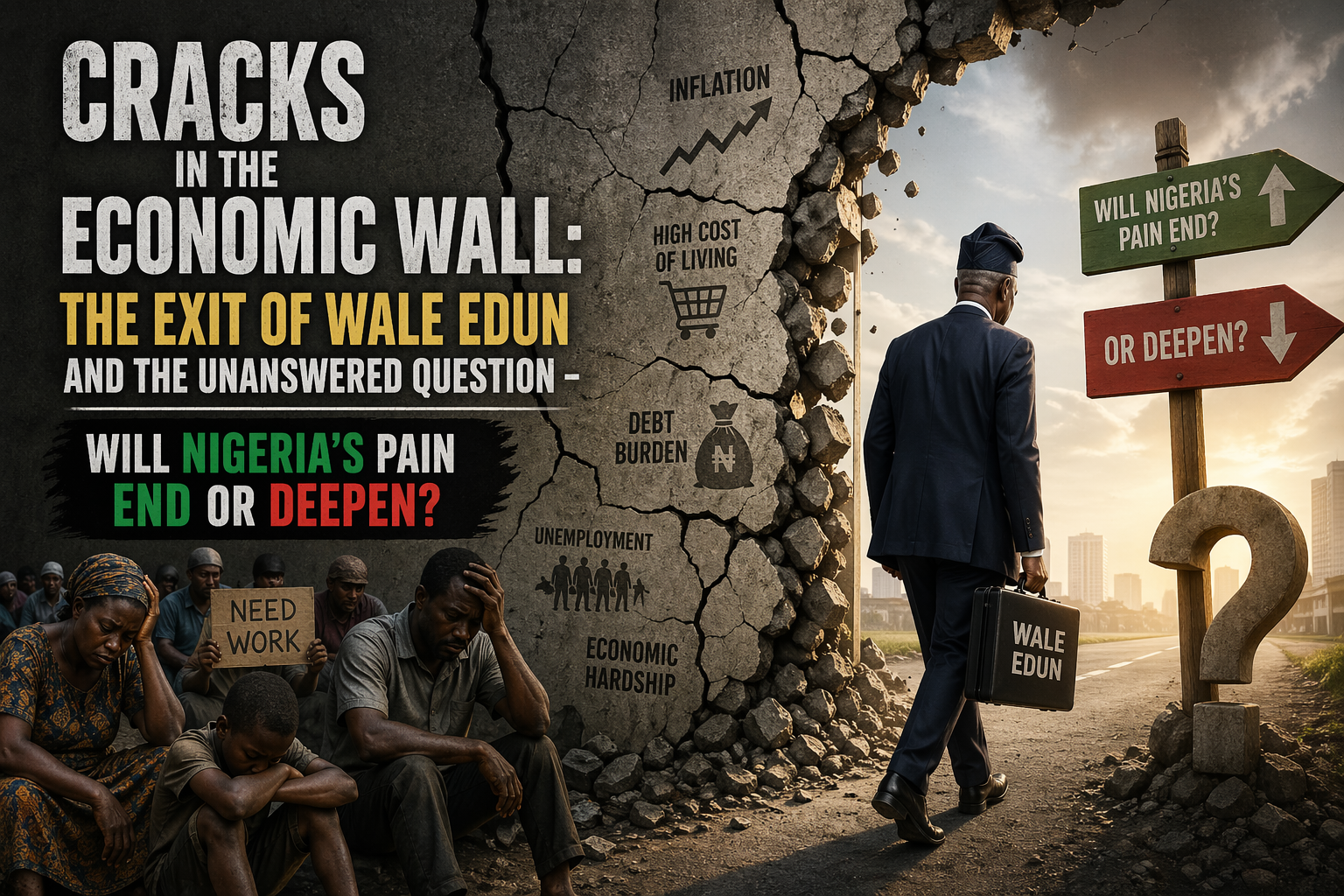
The sudden speculation surrounding the removal or sidelining of Wale Edun as Nigeria’s Minister of Finance and Coordinating Minister of the Economy has sent shockwaves through political, financial, and public circles. For many, this is not just a cabinet reshuffle – it is a moment that raises deeper concerns about the direction of Nigeria’s economic future and the persistence of hardship among its citizens.
At the centre of the debate lies a troubling dual question: Has a seasoned technocrat been sacrificed at the altar of politics? And more urgently, will the suffering of ordinary Nigerians now ease—or intensify?
A Technocrat Who Earned His Seat
Before his appointment by Bola Ahmed Tinubu in 2023, Edun had already spent decades building one of the most formidable economic careers on the African continent. Educated at the University of London and the University of Sussex, he began his global journey through the World Bank Young Professionals Programme in 1986.
His professional footprint spanned multiple continents—working on economic frameworks across Latin America, Asia, and the Caribbean—before returning to Nigeria to co-found Stanbic IBTC. His involvement in establishing West Africa Ratings (later associated with Moody’s) further cemented his role in shaping financial credibility systems.
From serving as Lagos State Commissioner for Finance under Tinubu to chairing Chapel Hill Denham and rising to continental prominence, Edun was not a political gamble. He was a calculated choice—a technocrat entrusted with fixing a fragile economy.
The Reforms That Shook the System
Edun’s tenure was defined by bold, often painful reforms widely seen as economically necessary but politically costly:
- Fuel Subsidy Removal — Ending a long-standing but unsustainable system, praised by institutions like the International Monetary Fund, yet immediately increasing living costs.
- Exchange Rate Unification — Designed to eliminate distortions and restore investor confidence, but contributing to inflationary pressures.
- Fiscal Transparency and Discipline — Expanding accountability mechanisms and tightening public finance systems.
- Reduced Reliance on External Borrowing — Focusing instead on domestic reforms and private sector-driven growth.
These policies were not designed to win public applause. They were structural corrections aimed at long-term stability.
Yet, for millions of Nigerians, the lived reality has been stark: soaring food prices, rising transport costs, and a shrinking standard of living.
The Timing: A Sudden Shift or Strategic Move?
What makes the situation particularly intriguing is the timing. Reports suggest that the shift followed high-level international engagements, including meetings linked to the IMF and global financial stakeholders. Just days earlier, Edun had publicly stated that Nigeria was not seeking IMF support, projecting confidence in the country’s reform trajectory.
This raises critical questions:
- Did global economic pressures clash with domestic political expectations?
- Was there a divergence within the administration over the pace and communication of reforms?
- Or is this part of a broader recalibration by Bola Ahmed Tinubu to manage public sentiment?
As one economist noted:
“When reforms begin to bite deeply, politics inevitably steps in to negotiate the pain.”
Who Has He Offended—Or What Has He Disrupted?
The notion that Edun may have “offended” powerful interests is not far-fetched—though the offence may not be personal, but systemic.
His reforms disrupted entrenched structures:
- Subsidy removal challenged networks benefiting from opaque fuel regimes
- Exchange rate unification closed arbitrage opportunities
- Fiscal tightening limited avenues for financial leakages
In essence, Edun’s policies may have threatened longstanding economic privileges.
At the same time, internal dynamics within the administration cannot be ignored. Economic hardship often translates into political pressure, and even the most loyal allies are not immune to strategic repositioning.
The Rising Influence of Taiwo Oyedele
Amid the uncertainty, attention has turned to Taiwo Oyedele, a respected fiscal policy expert leading Nigeria’s tax reform efforts. His growing prominence suggests a possible shift toward revenue-focused economic restructuring.
However, this does not necessarily signal a direct replacement, but rather a potential reconfiguration of economic leadership—one that may prioritize taxation and fiscal efficiency as central tools of reform.
Achievements vs. Public Reality
Edun’s tenure reflects a classic governance paradox: strong economic policies often produce weak public approval in the short term.
Achievements:
- Reinforced fiscal discipline
- Enhanced transparency in government finances
- Improved Nigeria’s credibility among global investors
Challenges:
- Rising inflation and cost of living
- Currency instability
- Public dissatisfaction and social strain
An analyst from the Brookings Institution observed:
“Stabilization policies are rarely popular—they are designed to fix systems, not to comfort citizens immediately.”
Will the Pain End—or Persist?
For Nigerians, this is the most pressing concern.
Changing a finance minister does not automatically reverse economic hardship. Structural issues—currency volatility, inflation, and systemic inefficiencies—remain deeply rooted.
If anything, sudden changes in leadership could:
- Disrupt policy continuity
- Create uncertainty in financial markets
- Slow the momentum of ongoing reforms
Yet, it could also open the door to:
- More socially responsive policies
- Enhanced economic communication strategies
- A recalibration that balances reform with immediate relief
A Strategic Reset or Political Maneuver?
The decision by Bola Ahmed Tinubu may reflect:
- Strategic Repositioning — Adjusting economic direction to deliver quicker results
- Political Balancing — Managing internal power dynamics and public pressure
- Policy Recalibration — Rethinking the pace and sequencing of reforms
As has often been the case in Nigeria, economic decisions are rarely isolated from political realities.
Conclusion: End of the Road or a Bend in History?
It may be premature to declare the end of the road for Wale Edun. Figures of his stature rarely fade—they evolve, often continuing to shape policy from different platforms.
What is clear, however, is that his tenure will be judged beyond the noise of present-day politics.
Nigeria now stands at a critical crossroads:
Will it stay the course of difficult but necessary reforms, or pivot toward short-term relief at the risk of long-term instability?
For citizens bearing the brunt of economic hardship, the answer cannot come soon enough.
Until then, one reality remains undeniable:
the problem was never just one man—and the solution will require far more than his